~/enrico-bergamini

Enrico Bergamini

applied economist · postdoc at ESADE Business School, Barcelona

$ whoami

I’m an applied economist working on the economics of innovation, economic geography and green industrial policy. I’m a postdoctoral researcher at ESADE Business School in Barcelona, where I work on the evaluation of Spain’s Startup Law.

I hold a PhD in Economics from Collegio Carlo Alberto and the University of Turin (2025). I was a research fellow at the University of Milan-Bicocca and, before the PhD, a research analyst at Bruegel in Brussels.

Most of my projects start by building datasets from messy sources (patents, firm accounts, newspaper archives, social media) and combine causal inference, spatial and network econometrics, and text-as-data.

research

job market paper

working paper

Climate Policy Uncertainty and Directed Technical Change: Evidence from European Firms

single-authored

abstract

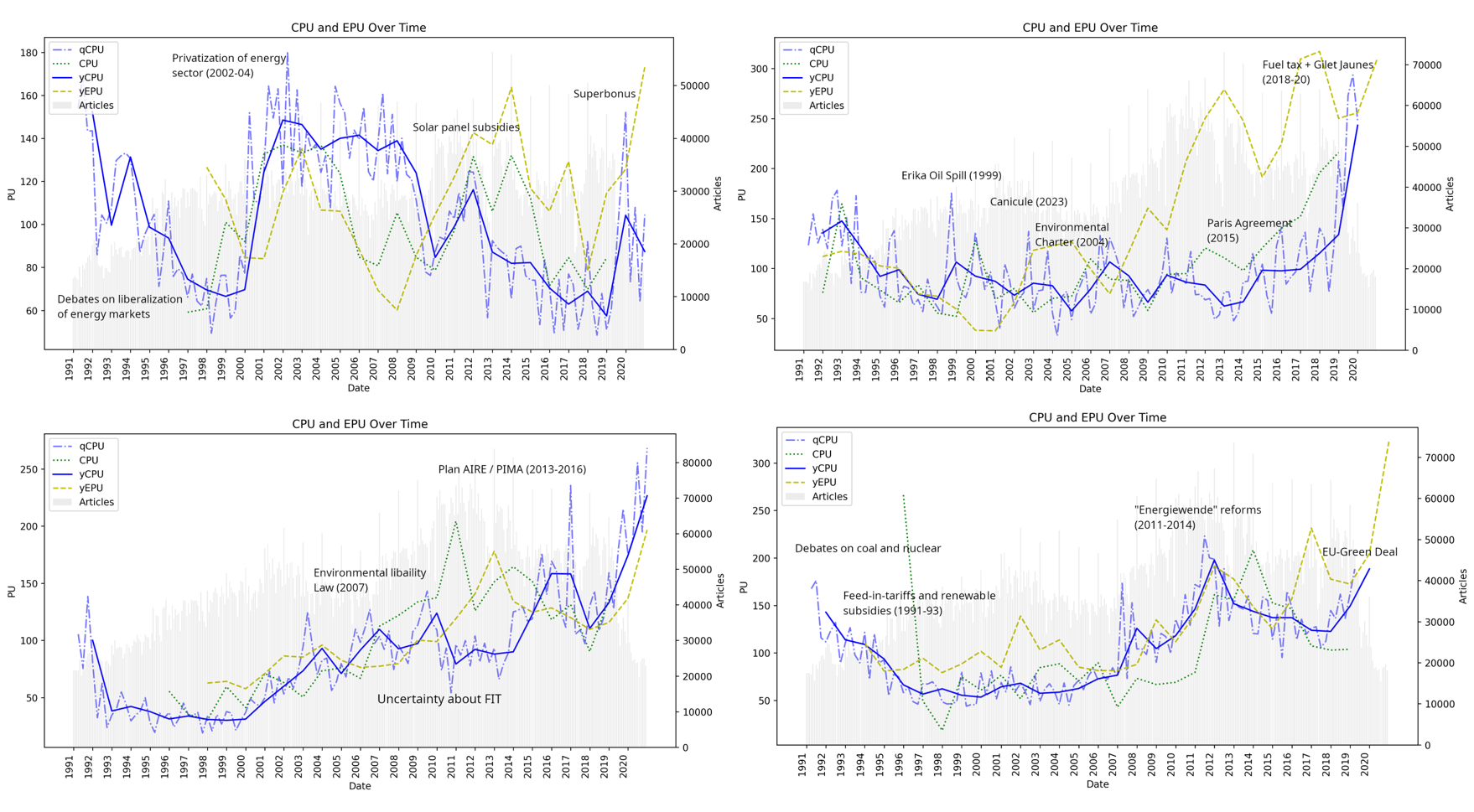
In this paper, I derive novel indexes of Climate Policy Uncertainty for four European countries. Exploiting a new dataset of web-scraped newspaper archives and text-as-data techniques, I explore the role of policy stance underlying aggregate indices of CPU, deriving sub-indexes for uncertainty suggesting increasing or decreasing future stringency. Building on the Directed Technical Change literature, I test empirically the relationship between CPU sub-indexes and environmentally-relevant technologies, in a panel of European firms between 1990 and 2020. I find a significant relationship between the direction of firms’ technological efforts, proxied by patents, and that of policy uncertainty. The results suggest that policy uncertainty is a relevant factor in affecting the direction of technical change, bearing important implications in terms of both climate and green industrial policy making.
publications

published

Green diversification, global knowledge sourcing and local skill composition: Evidence from the US

with Alessandra Scandura, Gianluca Orsatti, Francesco Quatraro & Fabrizio Fusillo

Research Policy 55(4), 105434 · 2026

abstract

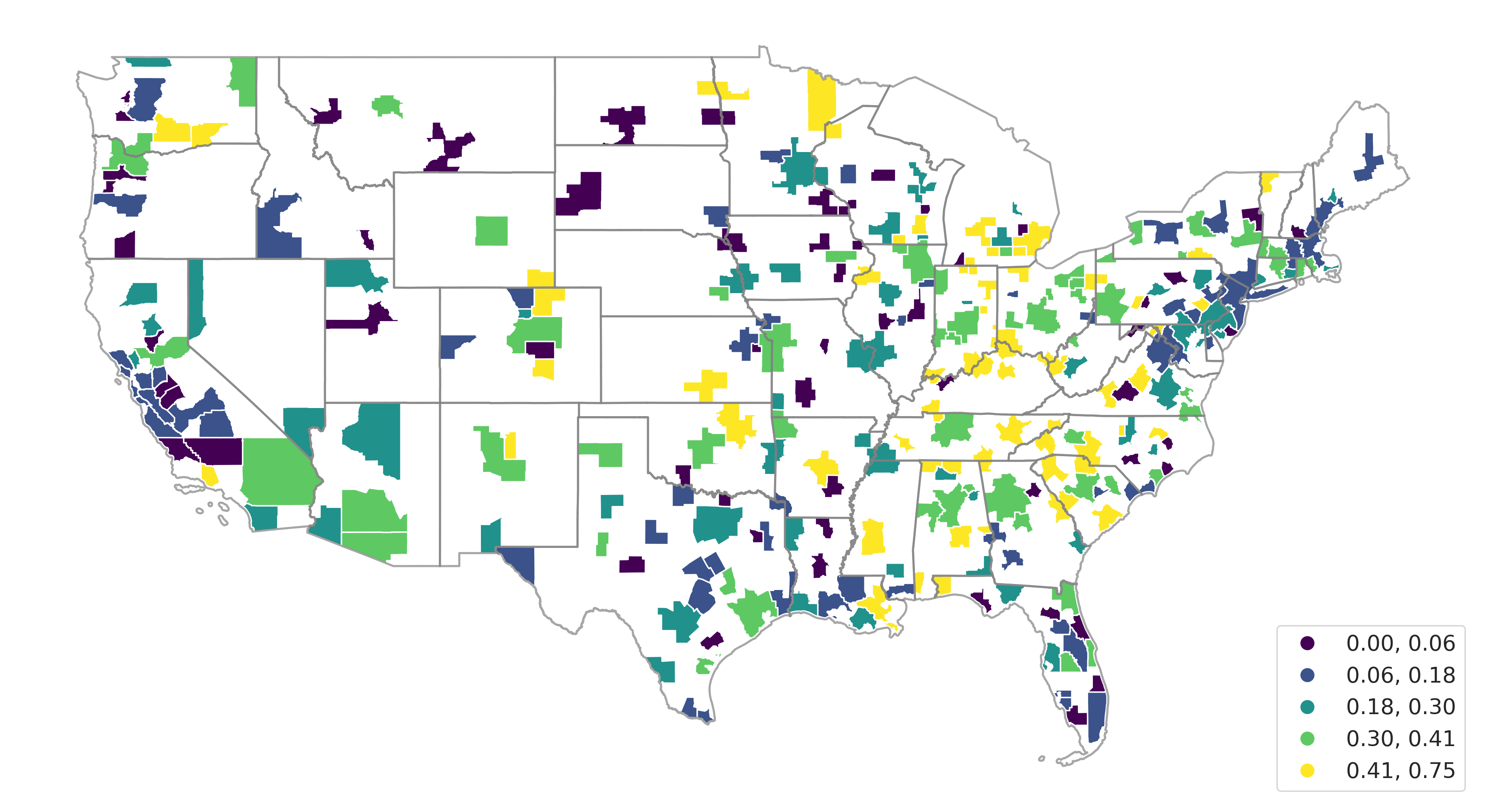
This work investigates the role of green foreign direct investments (FDIs) and local skill composition for regional technological diversification in green domains. We conduct the analysis on 287 US Metropolitan Statistical Areas (MSAs) observed from 2003 to 2018. Our results show that diversification in green technological domains is more likely to take place in MSAs with higher volumes of green FDIs and higher intensity of abstract skills. Moreover, we find that the local endowment of abstract and routine skills moderates the impact of green FDIs, activating compensation and reinforcing mechanisms, respectively. The findings of this work provide novel insights for the academic debate on the determinants of green technological diversification and for the design of an effective policy toolbox to sustain the regional green transition.

published

Economic union in the debates on the creation of the euro: new evidence from the tapes of the Delors Committee meetings

with Emmanuel Mourlon-Druol

Journal of Digital History 2(1) · 2024

abstract

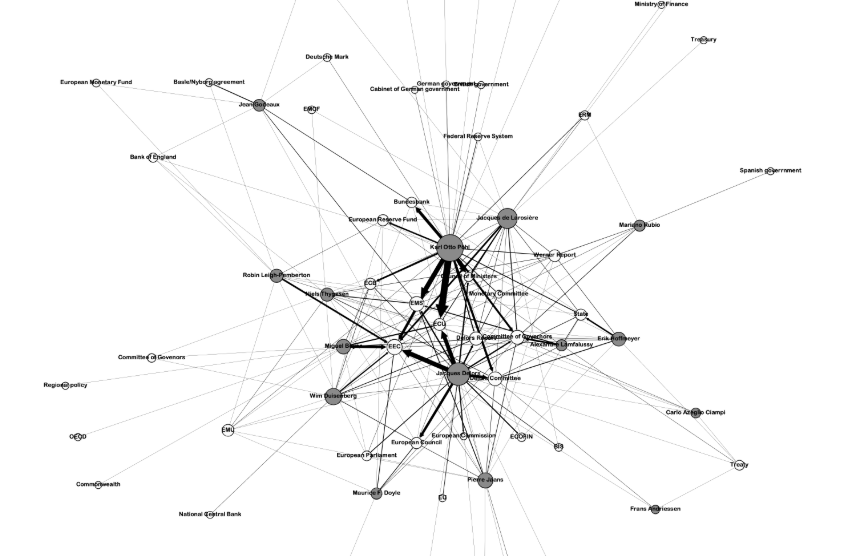
Economic union is often said to have been overlooked in the negotiations on the creation of the euro. While there are many accounts of the government and central bankers’ negotiations to create the European single currency, the discussions within the Delors Committee which drafted a report outlining how to create an Economic and Monetary Union provide unique insights into the debates. Through a mixed-method analysis combining several text mining and network analysis techniques with a close reading of the transcripts, and a listening of the tapes, the article explores the debates that took place within the Committee. We identify which, when, by whom, and to what extent were different topics raised in the Committee, and find that economic union was the second most discussed topic during the Committee’s meetings, after the design and functioning of the future European central bank. The article further shows that the real absence from the debates was the question of banking regulation and supervision.

published

Exploring EU’s Regional Potential in Low-Carbon Technologies

with Georg Zachmann

Sustainability 13(1), 32 · 2021

abstract

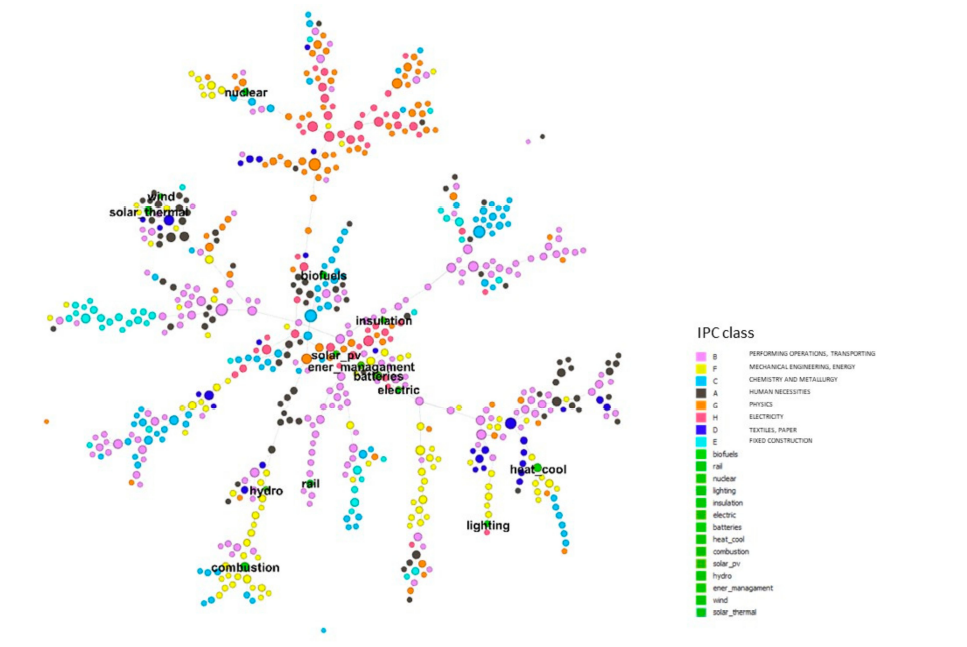
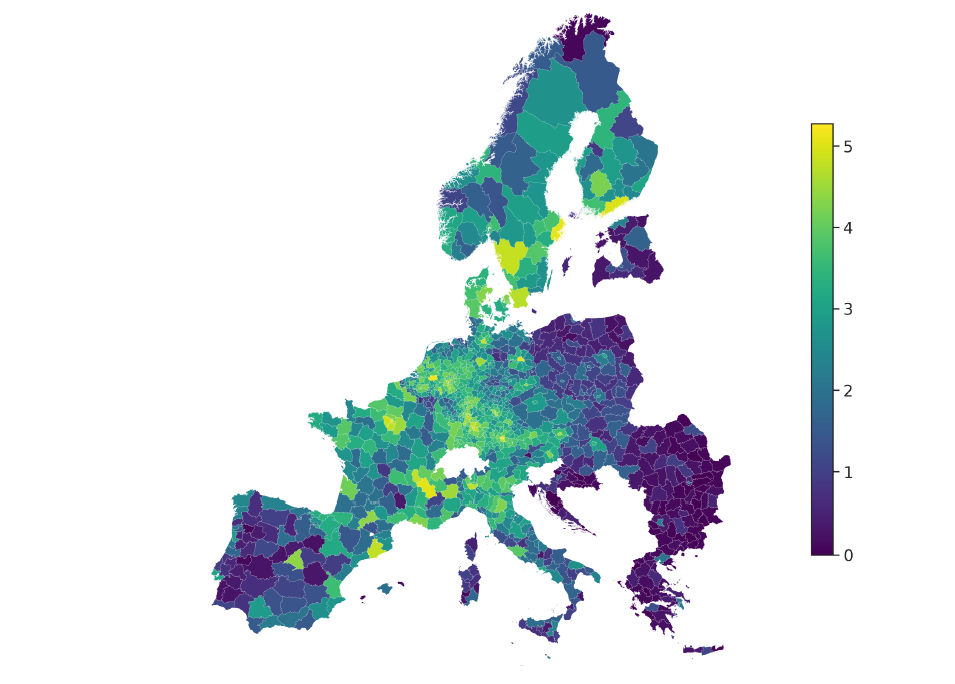
This research builds on the regional innovation literature, and aims to better understand the potential for, and development of, low-carbon technologies in the European Union. Exploiting the OECD’s REGPAT for regionalised patent data, we estimate the potential advantage of European NUTS2 regions have in 14 green technologies. We use network proximity between technologies and between regions to understand technological/regional clusters of revealed technological advantage and build the regressors for estimating regional potential advantage in specific technologies via zero-inflated beta regressions. Based on this, we explore the region-technology networks, finding two gravity centres for green innovation in France’s and Germany’s industrial and high-tech hubs (Île de France, Stuttgart, and Oberbayern). We also construct a dataset of lagged potentials and labour market, economic and demographic variables, and perform an elastic net regularisation to understand the association with current revealed advantages. Our approach indicates an association between technological advantage in green technologies and the (lags of) participation rates in labour markets, sectoral employment in science and technology, general higher education, duration of employment, percentage of GDP spent on R&D (public and private) and other expenditure on R&D. If confirmed by causality tests, the established associations could help in designing horizontal economic policies to enable specific regions to realise their specialisation potential in specific green technologies.

working papers

under review

Recombinant Novelty and Foreign Direct Investments: Evidence from European Regions

with Alessandra Scandura & Francesco Quatraro

abstract

This work investigates the determinants of technological recombinant novelty at the local level across European regions, focusing on the role of inward and outward greenfield Foreign Direct Investments (FDIs). We conduct an empirical analysis on a panel of 1136 European NUTS3 regions observed from 2003 to 2017. The results show that inward FDIs are positively associated with regional technological novelty consistently across several estimations. Outward FDIs are generally negatively associated with technological novelty but the relationship changes when we account for the geographical distribution of FDIs and the knowledge intensity of the investments. In addition, we employ a proximity measure between FDIs and the local knowledge base, which we find to be negatively associated with novel recombination efforts. The results of this work are relevant both for the academic discourse on local and non-local determinants of regional technological performances and for the policy discussion on the relevance of global connectivity for regional economic development.

under review

Mapping Scientists’ Tweets on Climate Policy across Disciplines and Instruments

with Ivan Savin & Jeroen van den Bergh

abstract

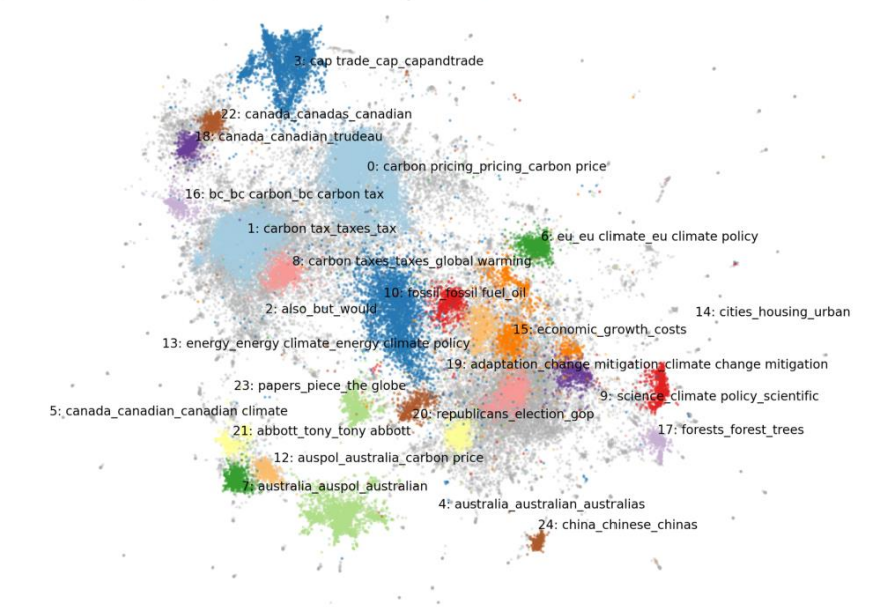
We study how scientists communicate about climate policy on Twitter/X between 2007 and 2022. Our English-language corpus comprises roughly 354,000 tweets, threads and replies from nearly 37 thousand scientists across 26 scientific fields, linked to OpenAlex metadata. Using computational-linguistics methods, we identify 25 topics, map discussion of specific climate-policy instruments, and compare communicative tone and policy stance across disciplines. We find that communication is strongly discipline-specific: economists focus on market-based instruments, while natural and environmental scientists devote relatively more attention to climate impacts and innovation support. Using an LLM classifier, we show that expressed stance diverges from sentiment and is predominantly supportive, with 70–80% of instrument-related tweets favourable. This pattern holds across every instrument and every scientific field, with explicit opposition remaining a minority even for the most contested policy instruments.

work in progress

policy

nowEvaluating Spain’s Startup Law (Ley 28/2022) at ESADE, with Vicente Bermejo, Joan Farre-Mensa and Martí Guasch.

More on my author pages at EsadeEcPol and Bruegel.

teaching & service